
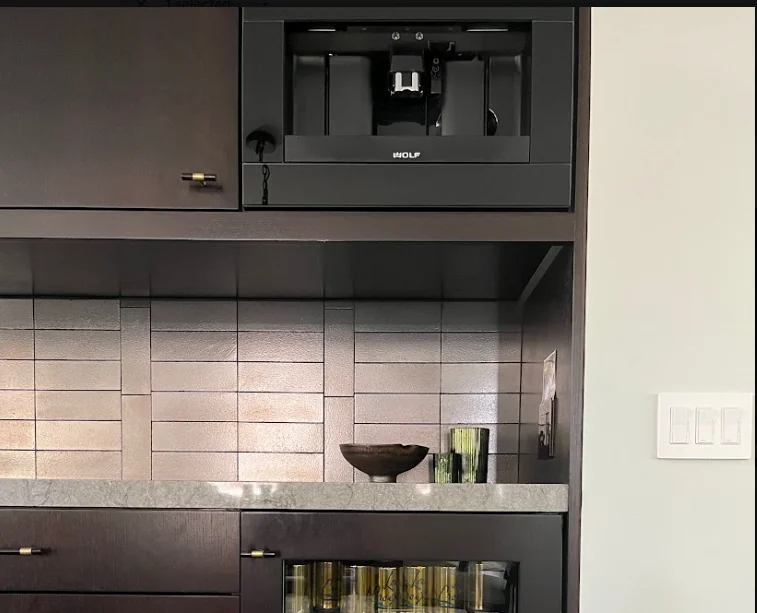
You are standing in a kitchen with walls that are not plumb, corners that do not meet at ninety degrees, and a ceiling height that falls between two standard cabinet sizes.
This is the moment the question of custom millwork vs stock cabinets stops being abstract and becomes personal. The choice you make here will affect how your kitchen looks, how it functions daily, and how much value it holds a decade from now.
The strongest answers come from a vertically integrated model, one that pairs residential design services with in-house fabrication. Design intent and construction execution stay under one roof. When your walls are out of square, the team that drew the plans is also the team milling the panels and scribing the face frames.
Keep reading to learn how stock, semi-custom, and fully custom cabinetry differ in materials, construction, and long-term return.
You will also see where each option fits best based on home type, timeline, and budget. By the end, you will understand how shop drawings translate a design concept into a finished, site-specific cabinet package.
How the Three Cabinet Paths Differ
A stock cabinet arrives in fixed sizes, typically in three-inch increments, from a factory that may produce thousands of identical units per week. Semi-custom cabinetry and fully bespoke work occupy progressively more flexible positions on that same spectrum.
What Counts as Stock, Semi-Custom, and Fully Bespoke Work
Stock cabinetry comes pre-built in standardized dimensions. You choose from a set catalog of door styles, finishes, and widths. Cabinet manufacturers ship these units quickly because they are already sitting in a warehouse or rolling off a production line.
Semi-custom cabinets offer more flexibility. You can modify door styles, adjust depths by small increments, and select from a broader finish palette. The manufacturer still works from a base catalog, but the modifications let you address some spatial quirks that stock cannot accommodate.
Fully custom cabinetry starts with raw material and a blank sheet. Every dimension, joint, panel profile, and finish is determined by your project’s exact requirements. Nothing is limited to a catalog.
Why Cabinetry Is Only One Part of Broader Millwork
Kitchen cabinets are the most visible component. Custom millwork also includes wall paneling, built-in shelving, library walls, range hoods, and integrated storage. When these elements are designed and fabricated together, the grain direction, finish sheen, and reveal lines stay consistent across the entire room.
Stock and semi-custom lines rarely extend beyond kitchen cabinetry. If you need a matching paneled refrigerator surround or a built-in banquette, you are sourcing from a different vendor. That split almost always produces visible inconsistencies in color, sheen, or profile.
When a Standard Product Line Is Enough
Stock cabinets work well in rental properties, secondary spaces, or kitchens with standard dimensions and no unusual architectural features. If your walls are plumb, your ceiling is a common height, and your layout does not require unusual configurations, a stock line can deliver a clean result at a lower price point.
The question shifts when your space demands something the catalog does not contain.
Custom Millwork vs Stock Cabinets: Fit and Integration
A two-inch gap between a cabinet run and a plaster wall is not a cosmetic problem you can caulk away. It signals a fundamental mismatch between a standardized product and a non-standard room.
Why Older Chicago Homes Expose Dimensional Limits
Chicago’s housing stock includes century-old greystones, workers’ cottages, and mid-century two-flats. These homes were built before modern framing standards. Walls drift, floors slope, and ceiling heights vary from room to room.
A stock cabinet designed for an eight-foot ceiling and ninety-degree corners will not sit flush in a kitchen where neither condition exists.
In a kitchen renovation in Chicago, field measurements often reveal that opposite walls differ by an inch or more. Ordering stock cabinets against those measurements means relying on filler strips, which break the visual line and collect grease.
Using Site-Specific Scribing to Eliminate Fillers and Gaps
Scribing is the process of trimming a cabinet panel or face frame on site so it conforms to the exact contour of an adjacent wall, ceiling, or floor. Custom fabrication shops cut panels slightly oversized, then scribe them during installation for a gapless fit.
This step is impossible with stock cabinets because you cannot trim a pre-finished, pre-edged panel without exposing raw substrate. Semi-custom lines sometimes allow minor scribing, but the finished edges and standard depths limit how far you can go.
The fabrication dimension matters here. In an integrated workflow, the millworker reviews field dimensions before cutting begins. Panels arrive on site with scribing allowances already built into the material. That connection between design intent and physical construction is what eliminates the filler strip entirely.
Designing Around Islands, Corners, and Built-Ins
Islands, blind corners, and built-in storage demand dimensions that stock lines rarely offer. Consider the following comparison:
| Feature | Stock Cabinets | Semi-Custom | Custom Millwork |
|---|---|---|---|
| Island depth options | Fixed (typically 24″) | Adjustable in small increments | Any dimension |
| Corner solutions | Lazy Susan or blind base | Wider selection, some custom pulls | Fully tailored to angle |
| Integrated appliance panels | Limited or unavailable | Available at upcharge | Standard offering |
| Built-in seating or shelving | Not available | Not available | Designed as part of the room |
| Hidden storage | Rarely offered | Limited options | Engineered to specification |
When your layout calls for a 38-inch-deep island with an integrated outlet panel and waterfall edge, stock and semi-custom options cannot deliver.
Materials, Joinery, and Daily Performance
The box behind the door determines how your cabinets perform ten years after installation. It is not the door style or the finish color.
Comparing MDF, Particleboard, Veneer, and Solid Hardwood
Stock cabinets typically use particleboard for the box and medium-density fiberboard (MDF) for door panels. Both materials are stable in controlled environments but degrade when exposed to moisture. A single dishwasher leak can swell particleboard beyond repair.
Semi-custom cabinetry often upgrades the box to furniture-grade plywood with MDF doors. This combination resists moisture better and holds fasteners more reliably over time.
Custom woodwork uses the material that best serves each component:
- Solid hardwood for face frames, stiles, and rails
- Furniture-grade plywood for box construction and shelving
- MDF for painted door panels where dimensional stability matters
- Wood veneer over plywood for stained surfaces that need grain continuity
Each material is selected for its role, not for cost minimization.
How Joinery and Hardware Affect Durability
Stock cabinets rely on staples, cam locks, and hot-melt glue. These fastening methods are fast to assemble but loosen under repeated stress. A heavily used drawer on cam-lock joints will start to wobble within a few years.
Custom joinery uses dado joints, mortise-and-tenon connections, and dovetailed drawer boxes. These joints distribute stress across a larger surface area and tighten with seasonal wood movement rather than loosening.
Soft-close hinges and drawer slides are standard in both semi-custom and custom tiers, but the mounting substrate matters. A soft-close hinge screwed into particleboard will strip its hole faster than one mounted in hardwood or plywood.
What Serviceability Looks Like After Move-In
A custom cabinet with bolted face frames and individually removable doors can be serviced without disturbing adjacent units. You can replace a single drawer front, swap a hinge, or refinish one panel without pulling an entire run.
Stock cabinets are harder to service because replacement parts follow the manufacturer’s production cycle. If a door style is discontinued two years after your install, matching it becomes costly or impossible.
Fabrication Standards, Finishes, and Quality Control
The Architectural Woodwork Institute (AWI) defines three grades of millwork quality. The grade specified in your project contract determines every tolerance, joint type, and finish standard your cabinets must meet.
What AWI and NKBA Signal in a Renovation Context
AWI standards cover everything from grain matching to gap tolerances. Premium grade, the highest tier, requires flush joints with no visible gaps and book-matched veneer across panels.
The National Kitchen and Bath Association (NKBA) provides guidelines focused on ergonomic layout and clearance dimensions. When you hire a millwork shop that builds to AWI Premium grade, you are specifying measurable outcomes.
The gap between a door and its frame will not exceed a defined fraction of an inch. Veneer leaves will mirror each other across a seam. These are not aesthetic preferences. They are contractual standards.
Stock and semi-custom lines rarely reference AWI. Their quality is governed by internal manufacturing specs, which vary by brand and price tier.
Why Shop Drawings Matter Before Fabrication Starts
Shop drawings are the detailed technical plans that translate a design into cutting lists, assembly sequences, and hardware schedules. They specify every dimension, material, edge treatment, and finish before a single board is cut.
Reviewing shop drawings before approving custom fabrication lets you catch conflicts early. A panel that looks correct in a 3D rendering may interfere with a plumbing chase or an HVAC register. Shop drawings expose those conflicts at a stage where changes cost nothing beyond a revised print.
Stock cabinets ship without shop drawings. Semi-custom orders may include basic layout plans. They do not reach the component-level detail that custom shop drawings provide.
Finish Consistency Across Cabinets, Paneling, and Trim
When your project includes cabinets, wall paneling, a range hood surround, and crown molding, finish consistency across all elements becomes critical. A custom shop sprays or hand-applies finish to every component in the same batch, under the same conditions, using the same formula.
Mixing a stock cabinet line with separately sourced trim and paneling almost always produces visible color shifts. Even the same stain applied by two different shops on two different days will look different under kitchen lighting. That batch-level consistency is one reason luxury kitchen designers specify single-source fabrication for high-end projects.
Finish options in custom work extend beyond stain and paint to include metal finishes, built-in lighting channels, and textured lacquers. None of these appear in a stock catalog.
Lead Times, Budget Pressure, and Long-Term Return
Stock cabinets ship in one to three weeks. Semi-custom lines typically require four to eight weeks. Custom millwork runs eight to sixteen weeks depending on complexity and material sourcing.
How Production Methods Change Timeline Risk
Factory-built stock cabinets carry the shortest lead time but the highest risk of back-order delays. A supply chain disruption at one plant can delay your entire kitchen by months. You have no alternative source for the same product.
Semi-custom lines operate on a build-to-order model. Your order enters a queue at the manufacturer’s facility, and timelines depend on current volume. Seasonal surges during spring and fall can push delivery dates beyond the quoted window.
A local millwork shop controls its own production schedule. Lead times are longer at the outset, but the fabrication happens within driving distance of your job site. If a field measurement changes after demolition, the shop can adapt the cut list within days. That proximity reduces the risk of a timeline-breaking surprise during installation.
Where Custom Work Can Protect Kitchen Remodel Budget
The sticker price of custom cabinetry is higher per linear foot. The total project cost, which includes filler strips, scribe molding, shims, and the labor to make stock cabinets look fitted, tells a different story.
Consider these common add-on costs when stock cabinets meet an irregular room:
- Filler strips and scribe molding: $300 to $800
- Additional carpentry labor for shimming and scribing: $500 to $1,500
- Separate trim fabrication to match cabinet finish: $400 to $1,200
- Replacement parts for discontinued styles (within five years): $200 to $600 per door
Custom work absorbs those line items into the base price. The result is a more predictable total budget with fewer change orders during installation.
Resale Value and the Cost of Replacing a Poor Fit
A kitchen renovation is one of the highest-return improvements you can make. Kitchens with built-in, site-specific cabinetry present as more polished and intentional than those with visible filler strips and mismatched trim.
The real cost of a poor fit shows up when you try to sell. A buyer’s inspector flags gaps, moisture damage at particleboard seams, and cabinet doors that do not close flush.
Correcting those issues before a sale often costs more than the premium you would have paid for custom work at the outset. That long-term math is what makes the final decision less about price and more about fit.
Choosing the Right Path for Your Renovation
The right cabinet path depends on three variables: your home’s physical conditions, your timeline, and the scope of work beyond the kitchen boxes themselves.
Best-Fit Scenarios for Stock, Semi-Custom, and Custom
Stock cabinets fit best in new construction with standard framing, rental properties where longevity is less critical, and simple galley layouts with no islands or built-ins. They also make sense when your timeline is under four weeks.
Semi-custom cabinets suit homes with minor dimensional quirks, moderate budgets, and layouts that require a few non-standard sizes. If your kitchen needs one or two modified boxes but otherwise follows a standard configuration, semi-custom delivers a reasonable balance.
Custom cabinetry is the clear choice for historic homes with out-of-square walls. It also suits projects with integrated millwork beyond the kitchen, and homeowners who want material and finish control down to the grain match. It is also the right path when your renovation includes wall paneling, library shelving, or built-in storage that must read as a single, unified installation.
Questions to Ask Before You Approve Shop Drawings
Before signing off on shop drawings, confirm the following:
- What AWI grade is specified, and what tolerances does that allow?
- Are field dimensions taken after demolition, or estimated from plans?
- Which materials are used for box construction versus door panels?
- How are finish samples approved, and will all components be finished in one batch?
- What is the change-order process if field conditions differ from drawings?
- Who handles installation, and is the installer the same team that fabricated?
These questions separate a rigorous process from a loose one, regardless of which tier you choose.
How to Match Scope to Timeline, Home Type, and Priorities
If your renovation includes only cabinets in a standard-dimension kitchen, a semi-custom line with a six-week lead time may be the most efficient path. If your project extends to built-in millwork like paneling, range hoods, and storage, a single fabrication source eliminates the coordination risk of managing multiple vendors.
Your home type narrows the decision further. A 1920s Chicago bungalow with plaster walls and uneven floors will punish stock cabinets. A 2020 townhome with laser-leveled framing will accept them without issue. Match the product to the building. Not the other way around.
Frequently Asked Questions
What Are the Main Differences Between Made-to-Order Cabinetry and Ready-to-Assemble Options?
Made-to-order cabinetry is built to your project’s exact dimensions using materials you select, with joinery designed for long-term durability. Ready-to-assemble (RTA) options ship flat-packed in standardized sizes and rely on cam locks and dowels for assembly. The primary differences are dimensional flexibility, material quality, and structural longevity.
How Do Labor, Lead Times, and Installation Complexity Compare Across Cabinet Types?
Stock cabinets install fastest because they require minimal on-site modification, but they often need filler strips and shims that add labor hours. Semi-custom lines take four to eight weeks to arrive and install with moderate complexity. Custom millwork has the longest lead time but typically installs with fewer on-site adjustments because components arrive pre-fitted to field dimensions.
What Cost Drivers Most Affect the Total Price of a Built-to-Spec Cabinet Package?
Material selection, box construction method, finish type, and hardware grade are the four largest cost drivers. Solid hardwood face frames, dovetailed drawer boxes, and hand-applied lacquer finishes each add cost over their standard counterparts. The number of non-standard dimensions and integrated features such as pull-out organizers or built-in lighting also move the total upward.
When Does a Semi-Custom Cabinet Line Make More Sense Than a Fully Bespoke Build?
Semi-custom makes sense when your kitchen has mostly standard dimensions with only a few quirks, your timeline is under eight weeks, and your project does not include integrated millwork beyond the cabinet boxes. It delivers better material quality than stock without the lead time or cost of a fully custom build.
How Do Material Choices and Finishes Impact Durability, Maintenance, and Resale Value?
Particleboard boxes degrade with moisture exposure and hold fasteners poorly over time. Plywood and solid hardwood resist both. Painted MDF doors maintain a smooth surface but show chips more readily than stained hardwood. For resale, kitchens with durable materials and consistent finishes across cabinets, trim, and paneling appraise higher than those with mixed-vendor components.
What Budget Range Is Realistic for a Full Kitchen Cabinet Replacement, Including Hardware and Installation?
For a mid-sized Chicago kitchen of roughly 150 square feet, stock cabinets with hardware and installation typically run $8,000 to $15,000. Semi-custom ranges from $15,000 to $35,000. Fully custom millwork, including soft-close hardware and professional installation, generally starts around $35,000 and can exceed $75,000 depending on material, finish, and scope.
The Decision That Shapes Every Morning in Your Kitchen.
The question of custom millwork vs stock cabinets comes down to how well the product fits your space, your daily use, and your long-term expectations. Stock works when the room cooperates. Custom works when you need the room to cooperate with your vision.
If your renovation involves a Chicago home with dimensional surprises, integrated built-ins, or finishes that need to read as one unified composition, a conversation with Threshold Design Lab is a good starting point.
The studio’s in-house fabrication through TDL Custom connects your design to the shop floor, so what gets drawn is what gets built. Tell us about your project when you are ready to move from planning to production.